

The Conversation Behind Abena’s Closed Door
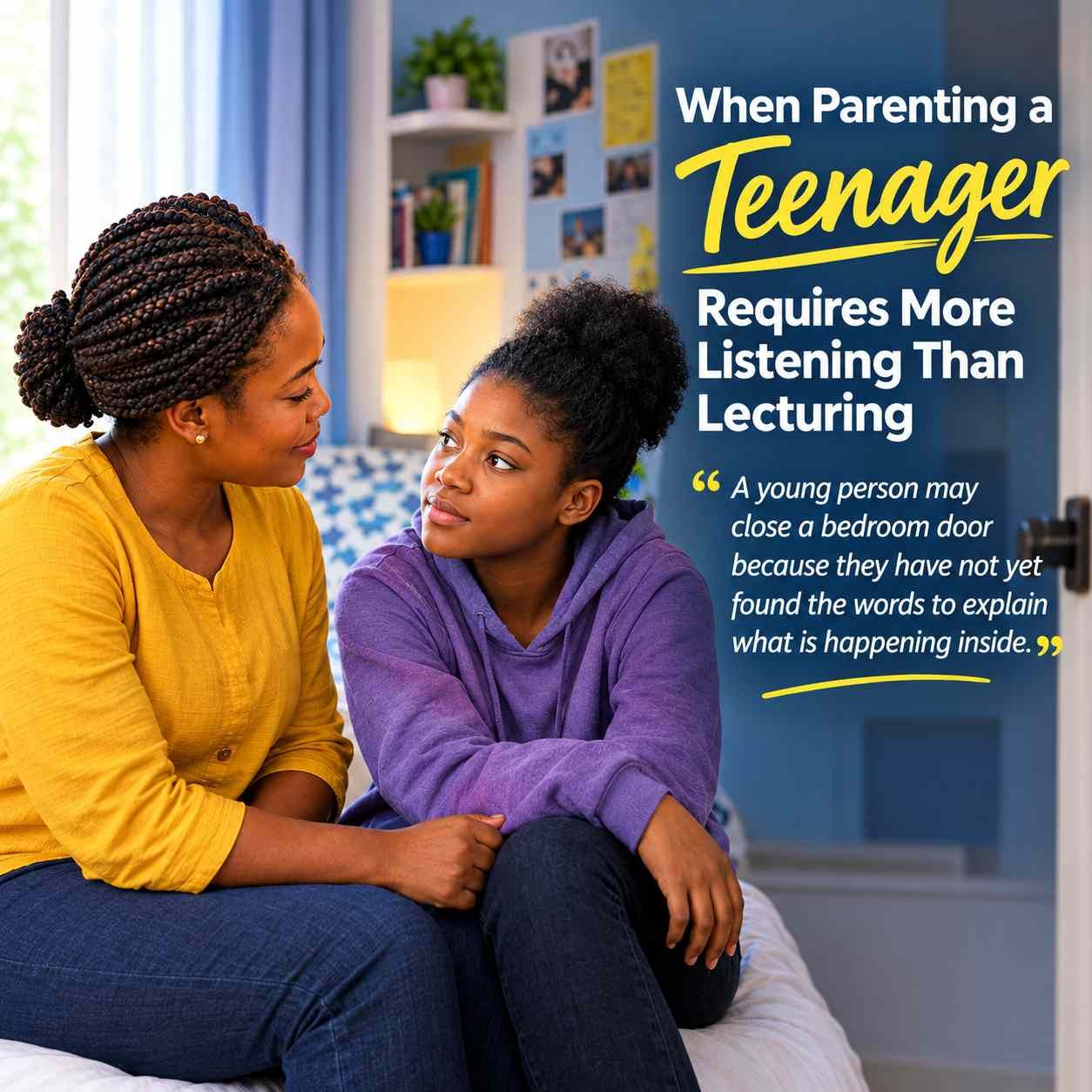
When Parenting a Teenager Requires More Listening Than Lecturing
“A young person may close a bedroom door because they have not yet found the words to explain
what is happening inside.”
For three evenings, Abena’s mother stood outside her daughter’s bedroom and wondered whether to
knock.
Abena was sixteen and had recently become unusually quiet. She still attended school, completed most
of her household responsibilities and answered questions about homework. But the lively
conversations that once filled their kitchen had almost disappeared.
When her mother asked what was wrong, Abena replied, “Nothing.”
Her father believed she needed firmer discipline. Her mother suspected the approaching examinations
were responsible. Both wanted to help, but neither knew how to begin.
Then a teacher called to say that Abena had stopped participating in group activities and seemed
increasingly withdrawn during breaks.
That evening, her mother prepared tea and knocked on the bedroom door.
“I don’t want to interrogate you,” she said. “I miss talking with you, and I want to understand how
things have been going.”
Abena initially remained silent. Eventually, she explained that two close friends had fallen out with
her, and unkind remarks were circulating in a class messaging group. She was also afraid of
disappointing her family if her examination results were lower than expected.
Her parents had been discussing revision timetables while she was worrying about where she would
sit at school the following day.
Adolescence involves changes in relationships, independence and the ways young people
communicate with adults. Parents may notice behavioral changes without immediately understanding
the pressures behind them.
The temptation is to fill every silence with advice. But advice given before understanding can make a
young person feel unheard, even when it comes from genuine concern.
Abena’s mother resisted the urge to solve everything that evening. She asked which parts of the
situation felt most difficult and what support her daughter wanted.
Together, they considered the school messaging problem, identified a trusted teacher and agreed on a
manageable study routine. Her father joined a later conversation, listening before sharing his own
concerns.
Progress was gradual. Some evenings Abena still preferred privacy. Her parents learned to distinguish
ordinary independence from changes that deserved closer attention.
If you are raising an adolescent, create opportunities for conversation that do not begin with
correction. Ask about friendships, online experiences, school pressure and what makes your child feel
supported.
Do not promise secrecy when safety could be at stake. If withdrawal, distress or changes in functioning
persist, seek appropriate professional support.
Young people also need to know that asking for help does not automatically mean punishment or
disappointment.
Several weeks later, Abena returned to the kitchen while her mother was preparing dinner. She pulled
out a chair and began describing her day.
Her mother put down the cooking spoon and listened.
A listening parent cannot prevent every difficulty, but can help make home a place where
difficult conversations are possible.
Share Abena’s story with a parent, caregiver or educator seeking a better way to connect with
teenagers
By Dr. David Rex Orgen, Best-Selling Author and International Mental Health Expert

Archives
- October 2026
- September 2026
- August 2026
- July 2026
- June 2026
- May 2026
- April 2026
- March 2026
- February 2026
- January 2026
- December 2025
- November 2025
- October 2025
- September 2025
- August 2025
- July 2025
- June 2025
- May 2025
- April 2025
- March 2025
- February 2025
- January 2025
- December 2024
- November 2024
- October 2024
Recent Posts

The Conversation Behind Abena’s Closed Door

When Forgetfulness Is More Than Carelessness

The Bus Stop Mothers: Everyday Care in Action
Tags
+1 (614) 753-3925
info@inspiremindglobal.com